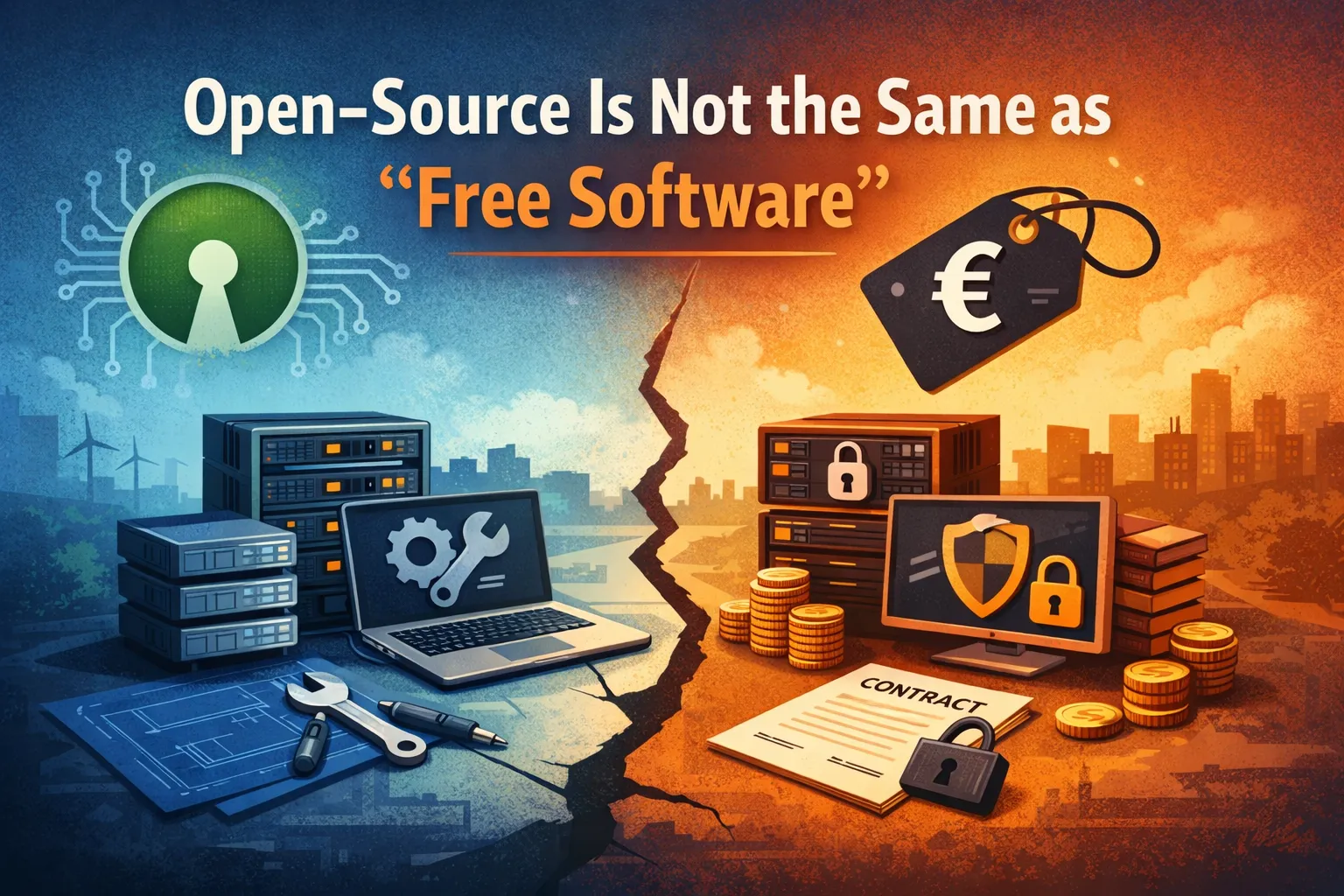
Open-Source Is Not the Same as “Free Software”
Open-source has a branding problem.
Somewhere along the way, it got flattened into a lazy assumption:
“Open-source = free.”
That assumption is wrong.
And in business contexts, it’s dangerously wrong.
If you make infrastructure decisions based on that misunderstanding, you don’t save money – you just delay the bill and multiply the risk.
This article draws a hard line between open-source software and free software, and explains the real cost of ownership, responsibility, and long-term control that come with using open systems correctly.
The Semantic Trap: “Free” Means Two Different Things
The confusion starts with language.
Open-source is about the second one.
Businesses usually hear the first.
Open-source does not promise:
It promises control, auditability, and independence – if you’re willing to own the consequences.
What Open-Source Actually Gives You
Open-source software provides:
That’s not “free”.
That’s ownership.
And ownership always comes with obligations.

Open-Source Removes the Vendor – Not the Work
Here’s the part people don’t like hearing:
When you choose open-source, you fire the vendor.
That means:
This is not a flaw.
It’s the trade-off.
You’re replacing a vendor relationship with internal responsibility or a trusted systems partner.
If nobody owns that responsibility, the system rots – slowly and quietly.
“Free Software” Is a Marketing Term, Not an Architecture Strategy
Many products marketed as “free” are actually:
They’re free until you depend on them.
At that point:
And your leverage is zero.
Open-source avoids this by design—but only if you understand what you’re signing up for.
Responsibility Is the Real Price

With open-source, you are responsible for:
None of these are optional in a real business environment.
Skipping them doesn’t make the system cheaper.
It makes failure inevitable.
The Illusion of “Saving Money”
Most businesses don’t fail with open-source because of the software.
They fail because they treat it like:
Open-source used correctly is often cheaper long-term.
Used incorrectly, it’s chaos with a GitHub logo.
There is no free lunch—only transparent trade-offs.
Long-Term Control Is the Actual Value

Open-source matters when:
It’s not about saving €50/month on licenses.
It’s about not being forced into a decision later when your options are worse.
Final Reality Check
Open-source is not free software.
It’s self-owned software.
If your organization:
Then proprietary services are not evil—they’re appropriate.
But if you want control, resilience, and long-term cost stability, open-source is the only honest foundation.
Just don’t lie to yourself about the price.