Let’s start by clearing the noise.
“Self-hosted” has become one of the most abused terms in IT.
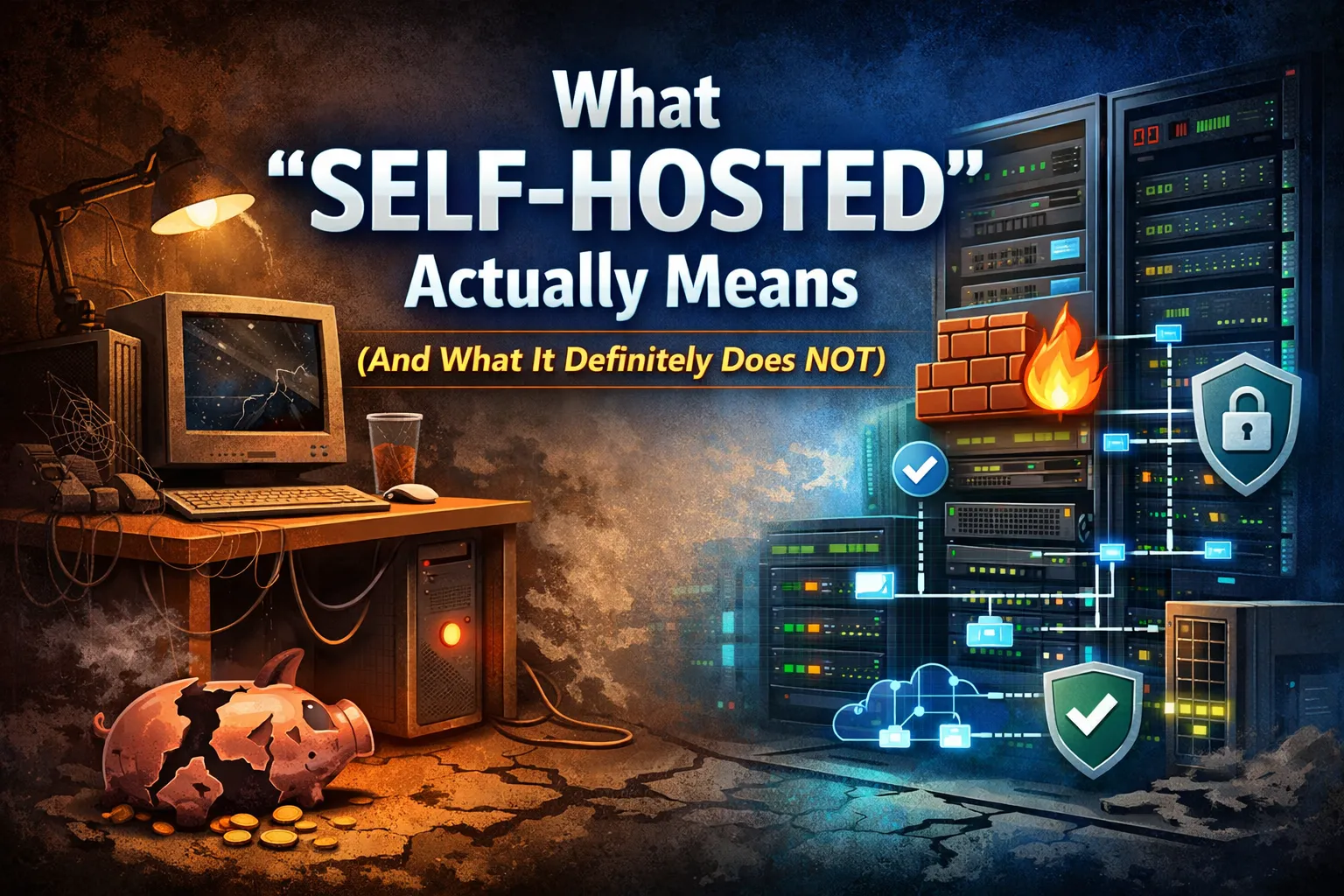
For some people, it means “a dusty PC under a desk.”
For others, it means “cheap at all costs.”
For many business owners, it sounds like “chaos, risk, and responsibility I don’t want.”
All of those interpretations are wrong.
Let’s clear this up – properly.
Self-Hosted Does NOT Mean “A Server Under a Desk”
This is the most common – and most dangerous – myth.
A random machine sitting in an office:
is not self-hosting.
That is home-grade IT pretending to be infrastructure.
Self-hosting has nothing to do with where the hardware physically sits.
It has everything to do with how the system is designed.
What actually matters:

Self-Hosted Does NOT Mean “Cheap for the Sake of Cheap”
Yes, self-hosted systems can reduce long-term costs.
That is a side effect, not the goal.
If your only objective is:
“How do we do this as cheaply as possible?”
You will end up with:
And when that person leaves – or the disk dies – everything stops.
Self-hosting done right is cost-efficient, not cheap.
You are trading:
for:
That requires design, not shortcuts.
Self-Hosted Does NOT Mean Chaos
Chaos comes from lack of structure, not from ownership.
Cloud systems become chaos all the time – just more expensively.
Real self-hosted infrastructure is:
Every service has:

What Self-Hosted Actually Means

Self-hosted means control by design, not by accident.
It means:
Not “we hope Microsoft/Google/AWS doesn’t change pricing again.”
A proper self-hosted setup includes:
Self-Hosted Is About Containment
Modern IT is not about preventing all failures.
That’s impossible. And anyone promising otherwise is lying.
It’s about ensuring:
Home-grade setups fail because:
Proper self-hosted infrastructure assumes:
“Something will break. The question is how much breaks with it.”

The Bottom Line
Self-hosted does not mean:
It means:
Done wrong, it’s a liability.
Done right, it’s an advantage most businesses don’t even realize is possible.
And no – it has nothing to do with a server under someone’s desk.
It has everything to do with ownership, structure, and control.