This Is Not a Cloud Hate Piece
Cloud computing didn’t “ruin IT.”
It solved very real problems – fast.
The issue isn’t using the cloud.
The issue is using it blindly, long after its trade-offs stop making sense.
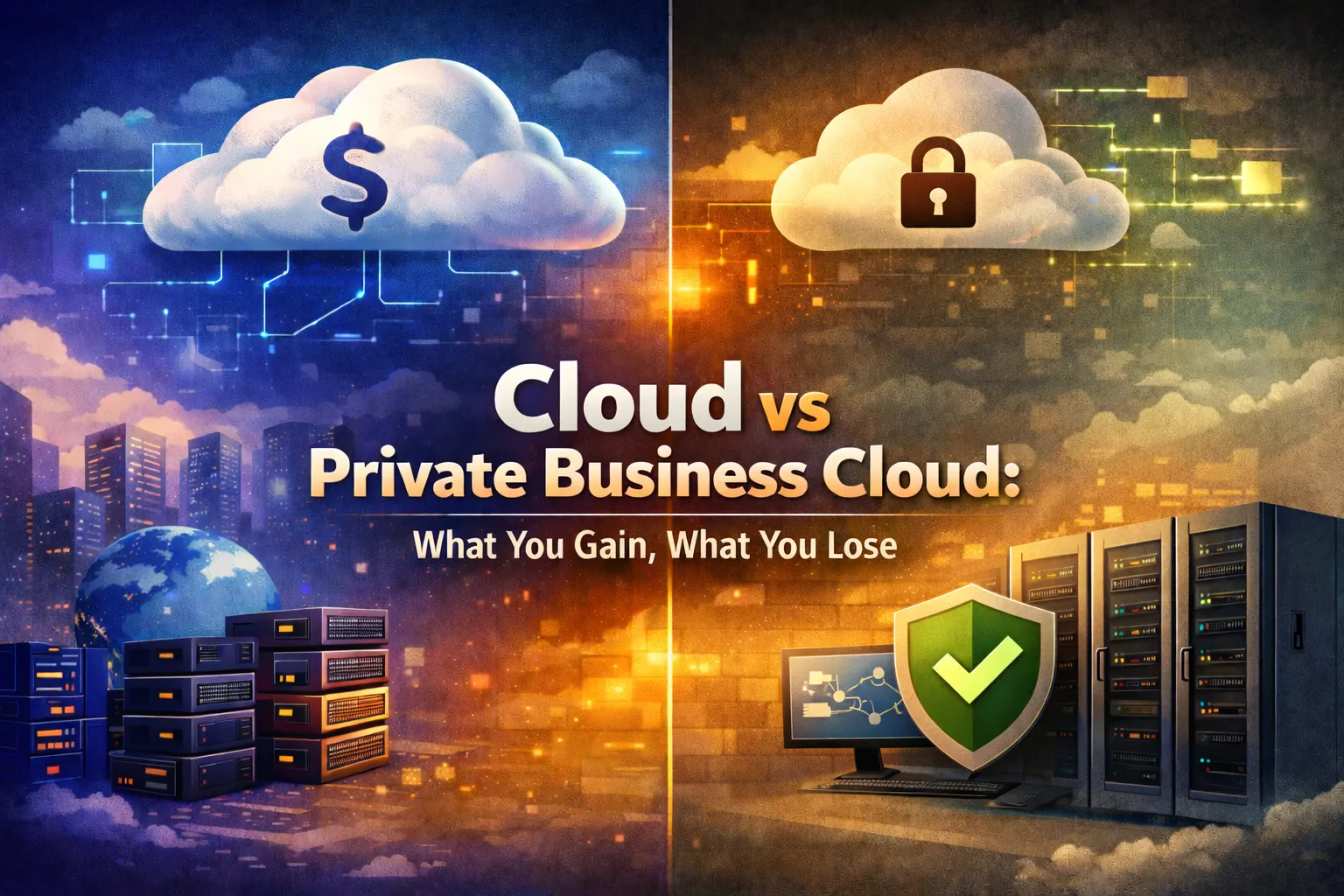
This article compares public cloud and private business cloud without drama.
No fear. No ideology. Just control, cost, and consequences.
What We Mean by “Cloud” (Let’s Be Precise)
When most businesses say “we’re in the cloud”, they usually mean:
A Private Business Cloud means:
Same principles.
Different power dynamics.

Where Public Cloud Wins (And Wins Hard)
Let’s give credit where it’s due.
Public cloud is excellent when:
Cloud is speed and convenience by design.
You trade ownership for momentum.
And sometimes – that’s exactly the right call.
Where Public Cloud Quietly Starts Costing You
Not catastrophically.
Quietly. Persistently. Structurally.
1. Costs That Scale Sideways
Cloud pricing rarely explodes overnight.
It creeps.
You’re billed for:
The cloud is cheap to enter. Expensive to mature in.
2. You Don’t Control Change – You React to It
In public cloud:
You don’t plan upgrades.
You adapt to them.
That’s not evil.
That’s the deal.
3. Your Architecture Is Shaped by Someone Else’s Business Model
Public cloud nudges you toward:
Over time, leaving becomes:
Not because they trap you.
Because they don’t design for your exit.
What a Private Business Cloud Actually Gives You

This is not “a server under the desk.”
This is not about control for control’s sake.
It’s about restoring cause and effect in your infrastructure.
A proper private business cloud gives you:
You decide:
Control isn’t about paranoia.
It’s about intentional design.
Security: The Awkward Truth Nobody Likes
Public cloud providers are excellent at infrastructure security.
But:
Most breaches aren’t hacks.
They’re permissions and assumptions.
Private cloud doesn’t magically fix security – but it forces clarity:

Compliance & Data Location: Suddenly Important
When data residency matters (and it eventually does):
If you need to answer:
Ownership simplifies the answer.
The Honest Trade-Off
Let’s be blunt.
| Public Cloud | Private Business Cloud |
|---|---|
| Fast to start | Slower to start |
| Low entry cost | Higher initial investment |
| Minimal ops | Requires discipline |
| Vendor-driven evolution | Self-directed evolution |
| Easy to scale | Easier to understand |
There is no winner.
Only fit for purpose.
Who Should Stay in the Public Cloud
Cloud is not a mistake here.
It’s a tool.
Who Should Consider a Private Business Cloud
This isn’t about saving money tomorrow.
It’s about owning tomorrow.
Final Thought: This Is About Maturity, Not Ideology
Cloud is not bad.
Private cloud is not heroic.
Mature IT is about:
If your infrastructure decisions happened by accident, that’s the real risk.
Eventually, every business has to decide:
convenience forever – or responsibility on purpose.