Yes — Sometimes the Cloud Is the Right Choice
If someone tells you self-hosting is always the answer, they’re lying to you.
If someone tells you the cloud is always cheaper, safer, and easier, they’re also lying to you.
Real engineering decisions live in the uncomfortable middle — where trade-offs exist, context matters, and ideology gets you fired.
This post exists for one reason: to earn trust.
Because the fastest way to lose credibility is to sound like a zealot.
The Rule You Should Start With
Before we talk about when not to self-host, let’s establish a rule that applies everywhere:
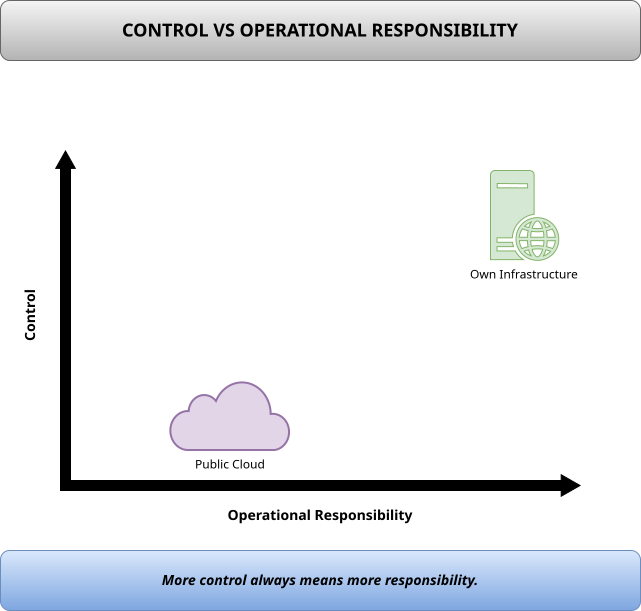
Control only what you can responsibly operate.
Self-hosting is not a moral victory.
Cloud isn’t a moral failure.
They are operating models, not belief systems.
1. When You Need to Move Immediately
If you need infrastructure now, not next week, not after procurement, not after a design review — self-hosting is the wrong tool.
Examples:
Cloud wins here because:
Self-hosting shines after the shape of the workload stabilizes — not before.
Use the cloud to learn fast.
Don’t confuse speed with permanence.
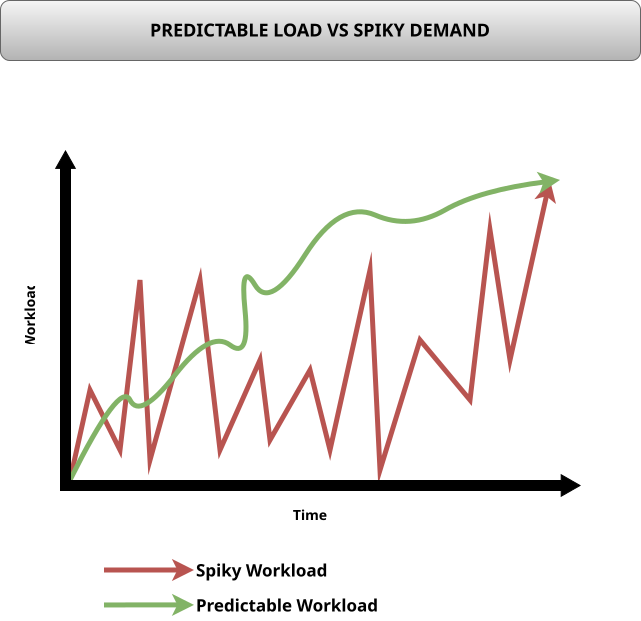
2. When Your Workload Is Highly Variable or Spiky
If your usage looks like this:
Then self-hosting may be a bad economic fit.
Why?
Because self-hosting means:
Scaling means planning, not reacting
You pay for peak capacity even when idle
Hardware sits unused waiting for rare events
3. When You Lack Operational Maturity
This one hurts, so let’s say it plainly.
If your organization:
- Has no monitoring
- Has no backups
- Has no access controls
- Has no incident response plan
- Has no one accountable for uptime
Then self-hosting will not magically fix this.
It will amplify it.
Self-hosting requires:
- Discipline
- Documentation
- Ownership
- Routine maintenance
- The willingness to say “this is on us”
Cloud platforms often hide operational incompetence behind managed services.
That’s not an insult.
That’s sometimes exactly what you need — temporarily.
4. When Compliance Is Outsourced by Necessity
Some industries require:
- Certifications
- Audits
- Attestations
- External guarantees
If you:
- Cannot afford audits
- Cannot staff compliance internally
- Need a checkbox today, not a roadmap
Then managed cloud services may be the pragmatic choice.
But here’s the uncomfortable truth:
You are not outsourcing responsibility — only evidence.
You still carry:
- Legal accountability
- Breach consequences
- Client obligations
Cloud compliance is borrowed trust, not transferred liability.
5. When the Service Is Not Core to Your Business
This one is subtle.
Ask yourself:
“If this service disappears tomorrow, does our business stop?”
If the answer is no, then self-hosting may be unnecessary risk.
Examples:
Self-host what defines your value.
Rent what is replaceable.
Owning everything is not strength — it’s distraction.
6. When You Need a Vendor-Provided Ecosystem
Some platforms exist because of their ecosystem:
Trying to self-host alternatives here can lead to:
If your team spends more time maintaining the tool than using it, you’ve already lost.
The Mistake to Avoid: False Extremes
Here’s where most discussions collapse.
People frame it as:
That framing is lazy.
The real axis is:
The Honest Position
Self-hosting is not for:
Cloud is not for:
A mature organization uses both — deliberately.
The Trust Test
If a consultant:
If someone can say:
“Here is where self-hosting makes no sense for you — and why.”
That person is worth listening to.
What Comes Next
In the next post, we’ll connect everything:
And show how hybrid thinking avoids both cloud dependency and self-hosted chaos.
Because grown-up infrastructure decisions don’t need faith.
They need clarity.