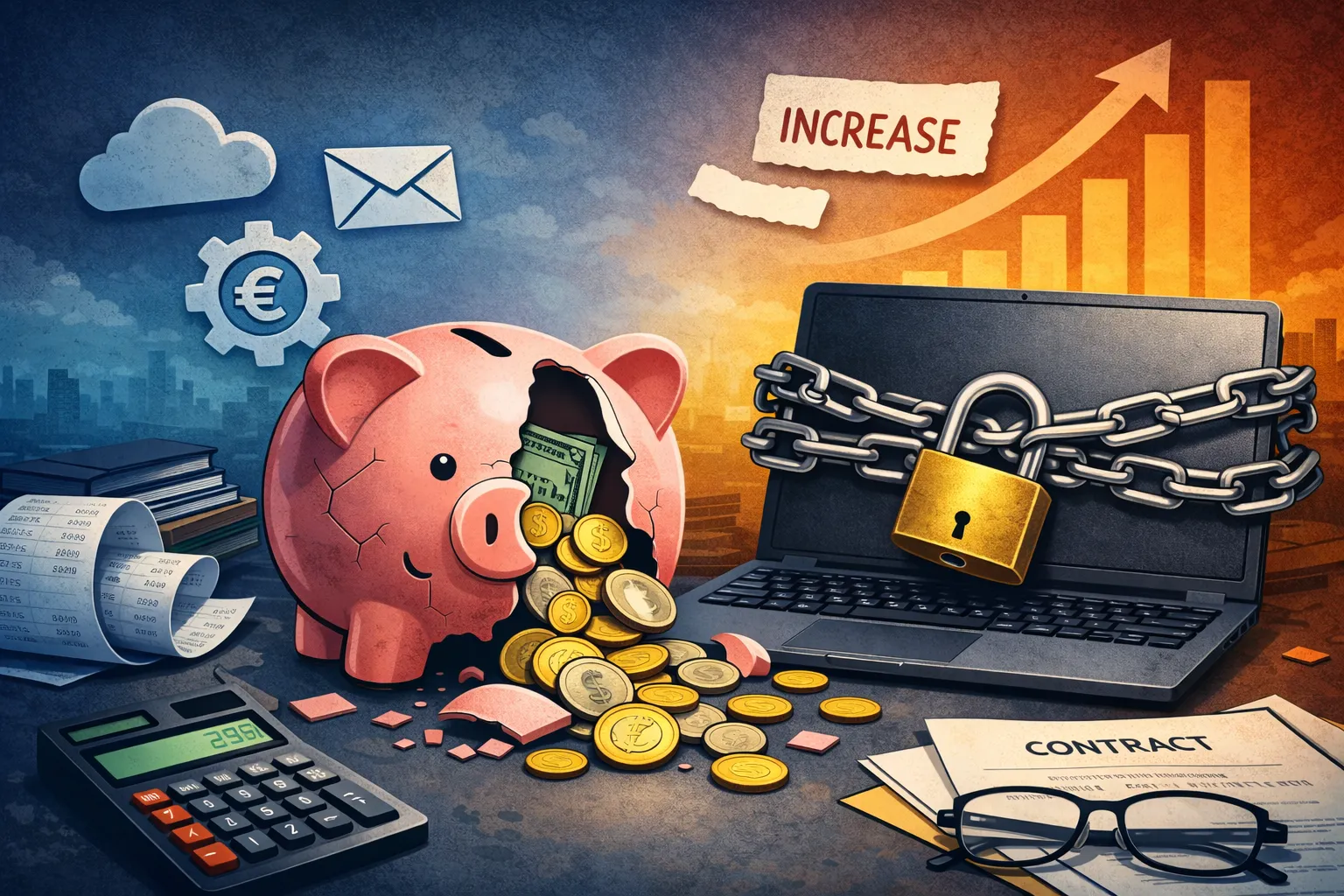
Subscription software looks cheap.
Until it doesn’t.
Monthly pricing feels predictable, controllable, and board-friendly. It slides neatly into OPEX. It avoids uncomfortable CAPEX conversations. It looks like good financial hygiene.
But that surface-level clarity hides three structural costs that never appear in the original budget — yet quietly dominate your long-term spend:
None of these show up in the quote.
All of them show up in your P&L.
This is not a rant against SaaS. It’s a reminder that subscription software optimizes for vendor revenue, not for your cost stability.
Vendor Lock-In:
The Cost of “It Would Be Too Painful to Leave”
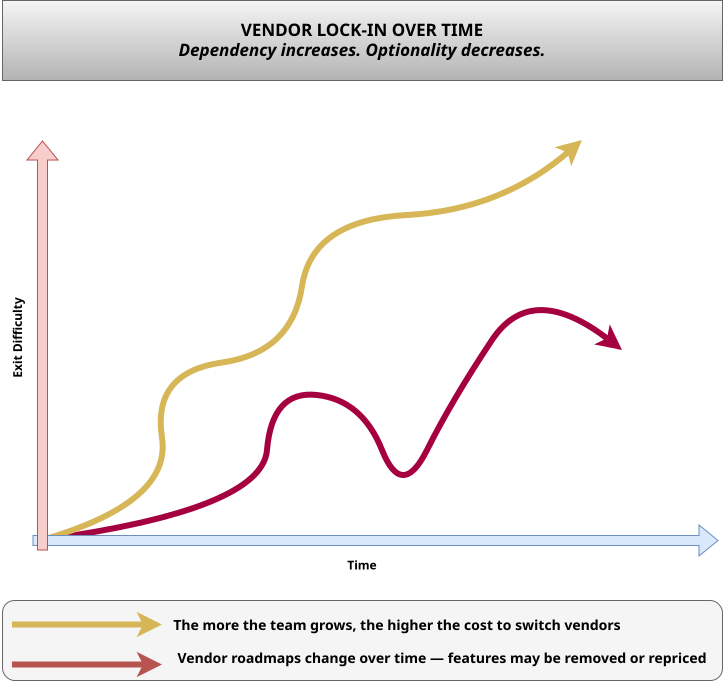
Vendor lock-in rarely arrives with a warning label. It creeps in through convenience.
At first:
Two years later:
The real cost of vendor lock-in is not technical.
It’s organizational.
Leaving doesn’t mean “switching software.”
It means:
So you stay.
Not because it’s optimal — but because the exit cost feels larger than the annual increase.
That is not flexibility.
That is deferred captivity.
Pricing Creep: The Silent Line Item That Always Goes Up
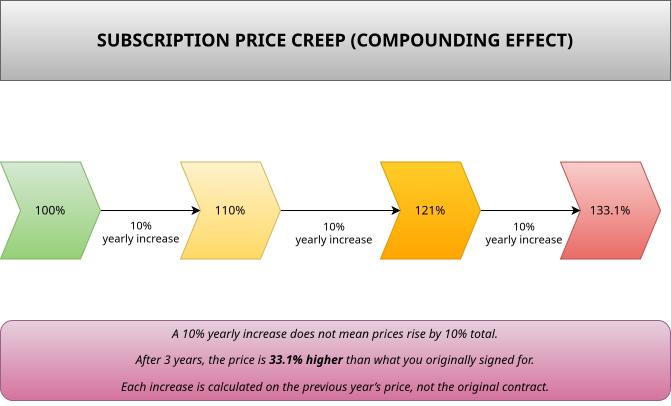
Subscription pricing is rarely stable. It’s directional.
Common patterns:
The problem is not the increase itself.
It’s that you no longer control the ceiling.
You don’t negotiate prices — you accept updates.
And because the software is now embedded:
Five years later, the same tool costs 2–3× more — with no proportional increase in business value.
That is not inflation.
That is asymmetry.
Feature Hostage Situations: When Capability Becomes a Negotiation
Feature hostage situations are subtle. They don’t feel hostile — until you need something.
Examples:
You don’t buy features because you want them.
You buy them because you now need them to operate responsibly.
Security, compliance, and governance slowly transform from basics into up-sells.
At that point:
This is the exact moment when cost stops being operational and becomes strategic.
And it’s never planned for.
The Budget Illusion: Why CFOs Keep Getting Surprised
Subscription software hides cost in four ways:
Each individual expense looks harmless.
Collectively, they form a permanent cost floor that only moves upward.
The problem isn’t lack of control.
It’s lack of structural leverage.
You can’t optimize what you don’t own.
What This Means (Without the Sales Pitch)
This is not an argument to “go fully self-hosted tomorrow.”
That would be reckless.
It is an argument for asking better questions before committing to long-term subscriptions:
Public cloud and SaaS are excellent tools.
They are just not neutral ones.
They optimize for speed and vendor scale — not for long-term financial predictability.
If you never model the exit, you are already paying for it.
Subscription software reduces friction today. Ownership reduces surprises tomorrow.